Thursday, January 25, 2007

* I have seen in the news lately, that in the States there
has been some pretty good sized snow storms.
  This morning it snowed for the first time since I have
arrived in Romania. As you can see in the picture below.


  You can also see that it wasn’t very much, so I guess
we’ve been pretty lucky as of now.
  For this region of the world it is unusual to receive snow 
this late in the winter season. It is a wild guess but I seems
we are like everywhere else, victims of global warming.
  There are two words for snow in Romanian. One is … zăpadă.
The other, which I really like the most, is … ninge … which
actually is pronounced almost exactly as the word … ninja ... 
your loveable assassins.
  It is always interesting learning a new language and having
to use it. But in the process of living in other countries, and
learning their languages, I have met some word redundancies.
  For example, 'unde' in Romanian means ‘where'. In
Senegal, in the Pulaar language, it means … to pound …
as seen in this picture below.


  Again in the Pulaar language, the word 'sappo' means 10.
  When I was in El Salvador (Spanish) sappo meant …
what’s in the picture below …


  yup it meant frog.

  I can easily understand if there are similarities between
Spanish and the Romanian languages. They are both latin
based.
  But it is interesting, that they also have, a word or two
that is used in an African language. Which as languages go
aren't even close .
  So I guess if unde can mean ‘where’ or ‘to pound’ and
sappo can either mean ‘10’ or 'frog'. 
  Though the words are spelled different but pronounced
the same.Why can’t ninge not either mean 'snow', or a
'silent deadly assassin'?

Wednesday, January 24, 2007

* I have never been in a country that has entered the
European Union before. Now that Romania has ascended
to the EU there will be enormous amounts of change.
  I will attempt to share, what I learn and observe,
throughtout the duration of my time here regarding
changes and their effects.
  Yesterday a friend of mine from Nădlac, who works as
a teacher in the city of Arad, (50 kilometers due east)
received information. It was that a controller of schools
was going to her high school with an agenda relating to EU
educational policies and methods.
  This is the first EU activity that anyone has been aware
of.
  The school system here in Romania does need change,
many teachers concur. The existing practices are that of
the somewhat outdated system of rote learning.
  One of Newton’s laws states that an object will continue
going along without a change of direction unless affected by
a force. I think that without the EU ‘force’ affecting it, the
educational system would stay the same.
  The school children of today are actually outdistancing
the teachers. The kids are from the 'information generation'
and due to the internet and other media, are actually more
advanced it their thinking.
  I have to state here that the people of Romania, in general,
are extremely intelligent.
  One big criticism of the educational curriculum is that
it doesn’t promote creative thinking.   That is why the
new EU guidelines should help turn it around.
  Many teachers are concerned that they will begin to
have some sort of problem as a result, but that is yet
to be seen.
  We all know that change is something that many people
fear. I guess you can resist and be stressed, or in this
case, where there is no other option, embrace.
  My thought is that it is going to be an truly interesting
time with a lot of opportunities for people with imaginations.
Hopefully it is all good imagination.
  Despite problems the educational future is actually bright.
There is no way but up.
  I will continue to monitor the school situation in Arad and
will keep you up to date on the changes and complaints.

Friday, January 19, 2007

 * Today I went to the store to buy things to eat. There
I met a teacher that I knew from the local school. Yesterday
I heard that the teachers will be receiving a pay raise. It
really is ridiculous the salary they get at the moment.
  I was interested to know if that was a result of Romania
entering the European Union. The raise isn’t a very big
one, but I was interested as to the history of the teachers
pay raises before the EU ascension. I have asked another
teacher the same question and the both of them couldn’t
answer me. I think that it is because I couldn’t get my point
across in Romanian.
  This led to a conversation concerning … information.
During the six months that I have been here I have tried
to observe what is going on. Where the problems originate
and the results that they bring.
  Almost from the first day here I have seen that there is
this incredible lack of information. Or more so, a hesitancy
to give out info.
  Despite the fact that the European Union is going to
transform their country, no one knows anything. No one has
heard anything concrete as to how it will be done. I hear
statements the people are making and they are mainly
rumors and fabrications, not based on fact. It is a no brainer
to say, that to make factual statements, one does need fact.
  OK, so why is this so? In this world of communications how
can this problem exist. There is TV, radio, internet and
everyone has a cell phone. There are projectors and whichever
other tool of communication, is here.
  Of course I am speaking about Nădlac. I am not sure of the
other cities and towns in Romania. But what I have seen, and
the suspicions that I have for why information is hard to
come by, is the following.
  Even though it is something like 17 years since the fall of
communism, it’s effects are still with us.
  I have learned that the Communists had a strategy to
control the people without having to have a ba-zillion police
or soldiers. In fact I have to give ‘the devil his due’ and say,
that even though I am not in agreement with that strategy,
that it was pure genius.
  The strategy was not to give information and also not
allow people to talk amongst themselves. I can't say that it
was not giving any info but it was selected info to their
advantage. It was a divide and conquer philosophy that
worked like a charm. Some of the people have told me that
it was dangerous to talk in public. People have told me of
having found bugs in their offices.
  So it is obvious to see that receiving information wasn’t
an habitual practice and discussion was a dangerous thing.
I think that this explains today’s problems with the sharing
of info. Despite the fact that it is 17 years since, the people
in power have learned their skills from that era. I am not
trying to say that the people are responsible because of
bad intent. Though I am sure that many are. It is just that
subconsciously you don’t give out info.
  So today in the grocery store I was having this discussion
with the teacher and at the same time another group of
people … (two ladies that work there, a lady around 50 years
old and a guy around 35) … were also having a similar
conversation.
  I basically butted in and told them what I have observed in
the 6 months that I have been here and that I agreed that
the lack of information is holding people back.
  For example, using the teachers pay as an hypothetical
situation. I am not sure what the teachers receive for pay
but it isn’t much. For arguments sake let’s say that it is
100 Euros a month.
  I know that one of the goals of the EU is to raise the
standard of living in each EU country to the point where
they are all somewhat equal. A practice that has
happened in each country that has entered the EU.
  OK, I know that, but the people here don’t seem to. OK
again, if the teachers for example knew how this EU thing
would affect them they could make a plan. Like if in 3 years
their wages will go to a certain level commensurate to other
teachers in other EU countries.
  How would that be a good thing to know? Well, they could
look into buying a house. Or save money to open a business
or basically be prepared and be right there in the middle of
the change and actually help to make it happen.
  But nooooo, they don’t know crapola and really don’t know
what tomorrow is going to bring. Or how it is going to affect 
their lives.
  Someone is responsible for getting the word out as to how
this transition is going to pan out.
  So back to the group in the store. The lady was basically
saying what I just wrote, and that no one knew anything
because no one wanted to give out information.
  Like I mentioned above, I told her I agreed. I also used
something what I learned during my time in El Salvador
(Central America) and that is the ‘mind of revolution‘.
  I told her that what the people need to do is start a revolution.
(I know this sounds like I am doing the wrong thing here
but don’t freak out, I will explain.)
  The group does kind of freak out after hearing me mention
'revolution' and I told them … I am not talking about a
revolution of violence. I am talking about an intellectual
revolution, where people start asking and looking for the
information and settle for nothing less. I told them that we can
use a weapon, at that time I went to the fruit rack and pulled
out a banana and pointed it at her. I told her we can threaten
to shoot bananas at them if they don‘t comply.
  They all laughed like heck and are probably still laughing now.
I told them that we can call it the ‘Banana Revolution for
information’. I don’t know if there has been a ‘banana revolution’
somewhere else but I doubt there has ever been one in Romania.
  There is a saying that ‘many a truth is said in gest’ and that
was my point. I know there was humor in that exchange but
there was also truth. With the big change in Romania due to
the EU ascension, it would be what I would have to say is, ‘nice’,
that people would have an idea as to what the ‘boggie’ is going
to be.
  So, hopefully over the next few months the information will
come without having to get the ‘Banana Revolution’ going.

Thursday, January 18, 2007

* I just happened to be going through some pictures the other
day. So I decided to put together this article that will show the
places that I have lived during my years in the Peace Corps.
  One feature that all the houses have in common, is that they
are all made of brick. In El Salvador it was mud with straw, in
Senegal is was mud and here in Romania it is kind of a mud brick.
  I will present them chronologically. The first picture is the
mud house from the village of Siguanango (which means in the
Nahuatl language ‘valorous women’) in El Salvador 2000-2002.
  
 For there, it was kind of nice. It had a dirt floor as I hope that
you see in the next picture. Also the shelving system was
made from bamboo and I tied it together with wire.
               
It was a good house but it had this damn mouse that probably is
still there. I battled with that thing for the 2 years. It was kind
of like the ‘caddy shack’ thing with the gopher.

This following picture shows the hut in the village of ‘Goundaga’
in southern Senegal 2003-2005. Goundaga in the Pulaar
language means ‘secret‘.
  

Next is the inside ...

      
I was lucky that I had a cement floor. It was a good hut and it
served me well for 29 months. The problems were, rain coming
through the roof during rainy season, bats, lizards and frogs. The
bats and lizards were really helpful against bugs. The frogs were
also, it was just that at one time I had about 80 of them under my
bed. Every night I could hear the bats fly in and catch the bugs.
  The next picture, also in Senegal and that was the
bathroom …
  
The tubs are the shower water and the hole is the toilet.
 The next picture is the back yard with the passion fruit plant over
the shade structure. The word for shade structure there is ‘charlie’.
  
I planted it and built the structure. It was really nice sitting under
the charlie on a hot afternoon.

The next picture is the house that I am in now in
Romania 2006-present.
  
It is a nice old house that is in decent shape.
The next picture represents the inside.
  

Next is the bathroom …

  
An upgrade from Senegal. I don’t have any pictures of
the composting toilets in El Salvador. But there, there wasn’t
any bathroom at all. To wash up, you were outside near the
well with your bathing suit on. Bathroom wise I feel that it
has gotten better each time.

The last picture is that of the back yard here in Nădlac. In
the summer it is beautiful.
  

So there is the ‘home sweet homes’ that I have had since
joining the Peace Corps.
  Though I am still making memories here in Romania daily.
Each one of these locations have served and are serving their
function well.
  Another thing that I have come to conclude, is that the true
experience of it all, is with the people. That is not to diminish
the experiences that living in these structures bring. I have just
come to the conclusion that the place/country/village is really
the people.
  With that I have to say that I have been very lucky for I have
lived with some extraordinary people. Even at this moment I
am meeting new people daily. Each one as uniquely different
from the last.
  I guess that I should finish by saying that these houses
where/are my home. What I enjoyed the most is that as diverse
as the houses have been, so have the countries they are in.

Tuesday, January 16, 2007

 * Being a Peace Corps volunteer does take you to unique
places and also at times it puts you in unique situations.
There are many situations that could be described as just
plain totally, crazy. But those are exceptions that make
for incredibly great stories. Every volunteer has experienced
them at one time or another.
  What I would like to write about here is the not so
spectacular situations that occur almost daily. I am talking
about having to deal with the customs of the people of
the country you are in.
 In Senegal and here is Romania there is a custom to
invite people over to eat. In Africa it was just the
chance of walking by while the people were eating that
would get me an immediate invitation. Here in Romania
it is similar but it is more like, when they get you there,
it is … eat more, come on, eat more, you didn’t eat enough.
  In Senegal the problem was that I usually had eaten two
houses before and again I ate two houses before that.
  It is about giving hospitality and also receiving it. For us
volunteers sometimes it can get to be enough.
  Also, it can be somewhat of an insult to reject someone’s
offer. It can get a little tricky with trying not to offend people.
I am sure that other volunteers have their strategies on how
to respectfully decline without offending.
  I am going to describe two strategies that have worked well
for me. The first one is what I am using here now in Romania.
When I am full and can’t eat anymore I simply use this line.
‘Nu vreau ca eu am o burta mare, femea nu place’. In my not
so good Romanian it actually means that, I don’t want to eat
more because women don’t like guys with big stomachs. They
look at me, laugh and that’s it, pressure’s off.
  In Senegal it was somewhat a similar strategy. I lived with
the Pulaars and there they have this thing about eating beans.
When we first got there we had some kids that asked us for
money and didn’t get any say … ‘a namii niebe’. Which
means … you eat beans.
  We went back to the trainers and asked them, what do
they mean by that? What they were referring to was that
you ate beans, and farted. I guess you can see where the
beans fit in.
  When I arrived in the village, I didn’t know the language
well enough to decline politely and really wasn’t sure if you
could. But the invitations to eat just kept coming.
  What did happen when I knew what was up was I developed
a method as to how to get out of eating every two feet, without
offending anyone.
  I would say this ‘a jaraama, mi harii, si mi namii, mi riddat’
which means … thank you, I am full, if I eat, I will fart.
You should have seen the look on their faces the first time
I said that. No one would have even thought to say that. I
have to tell that it worked like a charm.
  I swear people would keep inviting me just to listen to me
say that.
  What it did do was get me out of eating and it didn’t offend
anyone. They just laughed their heads off.
  It is kind of fun trying to find out how to get out of situations
like that and not be offensive.
  I had a Senegalese friend from the city that would visit me
in the village and she would hear me say the ‘ if I ate more I
would fart' line.
  She would tell me that despite the fact that I was from the
States, and had an education, I talked like I was uncivilized. I
have to say that I thought it was funny to hear her say that.
She was probably right but being a volunteer/foreigner and
having to try and walk through the cultural minefield without
offending anyone, can be pretty tough. Sometimes you need
to be creative.
  Again, maybe she is right and talking 'uncivilized' isn’t all
that pretty. But what I do know is that I never did have to
‘eat till I farted’ and in the process made people laugh.
So I guess it worked.

Sunday, January 14, 2007

One step forward and two steps back

... you don’t get too far like that. That is a line in a reggae song.

   This probably best describes the sequel to the Monday,
November 13, 2006 blog entry. The story about the ‘prom king and queen’.

   Despite that it wasn’t a very nice incident, it had a powerful
positive effect. Everyone found out about it and there was a major
discussion in town. All the people knew the young Rroma girl who
was not allowed to win the contest due to her origin.

   It really was a major step forward. People of all cultures weren’t
happy with the injustice that occurred that night.

   Fast forwarding a month and a half … it is the holiday season.
The lady responsible for changing the results against the Rroma
girl put together some packages of clothes and maybe a few other
articles to distribute to the Rroma (Gypsy) community.

   I must interject an opinion here, before this gesture, I didn’t have
much of a positive view of this lady. But now, I have to say that
I respect her, the fact that she realized that either with or without
a good heart, she was wrong. The general consensus was that she
was attempting to make amends. It was the first time that she had
done anything resembling that act of generosity.

   At this point you have to start thinking that things worked out
pretty well. There is a happy ending to a situation that began in a
not too pretty manner.

   This is one step forward, really, a giant step in fact.

  Ok … it would be a great world if it was that easy.
What happened was that the recipients, instead of actually saying
thank you, asked for more. This immediately infuriated the
lady who was at the time sucking up her pride and in essence was
holding out the ‘olive branch’. You know, I don’t blame her for
being upset. I wish I had a dollar for every time that happened to
me in Africa.

   Results of a lack of appreciation … two steps back.
This could open a huge discussion regarding the differences between
peoples from different cultures, social or financial statuses.
What should have happened? If the recipients had a little knowledge
and understanding of who they were dealing with. They would have
realized where this lady came from and that it was an opportunity.
Nothing more than a sincere thank you and patience, would
most probably bring them further benefits in the future.
As much as the discriminators need to be enlightened, it appears
that likewise, the discriminated also need to be enlightened.
It is interesting to note that a lot of people think that equality is
really a result of economic issues. But it is really a lot more than that.
I have been in very poor places in the world and yes, economics do
limit development. However, the more I see situations like this,
the more I am convinced that it is more ‘the mind’ that arrests the
progress out of discrimination and poverty. The saying goes … the
mind moves the body. The direction is dictated by the thought. This
is relevant for everyone from the top to the bottom of the ‘totem pole’.
Sometimes all it takes is a little appreciation to change someone’s
heart. Appreciation given is like a drug, the more that one receives,
the better one feels. People do incredible things to make themselves
feel good. Sometimes all it takes is a good act to get what people
spend millions for … to feel good. So I am sure that if the lady
received appreciation instead of more demands, she would have
felt good about herself. This could have led to other generous actions
from her in the future.

   I guess the conclusion is best put by someone called Frost ( I think
it was him) … many miles before we sleep.

Friday, January 12, 2007

R-E-S-P-E-C-T … read, and find out what it means to me

   I think that Aretha Franklin was on to something hugewhen she sang that song. It isn’t only something that had
importance at that time. It is essentially more important
now, than then. Well, in my life anyway.

   One of the things that was taught to me by my parents
was to respect everyone you meet. It is kind of easy to do
that when we are in our own environments. We
have our families, friends, jobs and any other something
that is what is usually, our everyday lives. Being in your
own cultures sure helps out. Especially when you don’t
have to go against so many stereotypical views.

   I am writing because of the experience that I have had
today.

   Today, as every day, I went to the coffee shop for around
9:30 a.m. It is about being visible and integrating
into the community, plus the coffee.

   What happened is that I ran into a Rroma (Gypsy) guy that
I have started to become friends with. This doesn’t sound
like a big deal, but it was. The reason being as this guy is
quite an outsider. I have heard that he spent time in jail
for murdering someone (but I seem to get mixed info, from
different people) also he is poor, doesn’t work (don’t know
why) and he is what I have to call, the town ’moocher’.

   It is interesting to see the reaction that everyone has to
him. I can understand why and that is the peoples’ right.

   One thing that I do have going and enjoy a lot is being
the ’stranger’. At first back in El Salvador it was difficult
because I was always on the defensive. I was somewhat
manipulated into doing what the people wanted me to do.
I felt that I had to follow their customs and it was like
playing their game where they would use my ignorance to
change the rules for their advantage.

   I suffered through that for the first year and I finally
figured out that, hey, I am not you, I am different. When
I realized that, life got so much easier and I began to call
some of 'the shots'.

   In the five years since, I have used this line … ‘I do things
different because I am different‘. I am not Salvadoran,
Senegalese or Romanian for that matter and I tell people
this all the time. I do respect the cultural norms but the
small things I do a little more ’my way’. For example here,
usually the men shake hands and a man doesn’t shake
hands with a woman. But I shake hands with women and I
can tell that they are a little surprised by it. Every time I
say, I am doing this differently because I am different. The
point I am trying to make is that there are people different
than you and accept them for that. So far the people have.

    The real word that should be used for development is
’change’.

   How does this fits in with the Rroma ’moocher’ man? I
buy him coffee about twice a week and we talk.

   An ex-volunteer friend of mine in Senegal (Pat, who is
a psychologist) told me that once you gave someone
something, they would keep coming back knowing that
if they persist, they will probably score again. Right here
I am saying thanks to Pat, because by understanding that
I have been able to manipulate them, instead of them
manipulating me.

   The reason why I want contact with this guy is because
he is arguably at the bottom of the social totem pole.
Where is a better place to get info on how it is be an out-
cast here in Nădlac.

   This morning we spoke for quite a long time and we also
were out in an open area. It was funny to see the reaction
of the people that I knew. They were really uncomfortable
and barely said hi to me because I was with the Rroma gent.
I understand why, they have been in town with him more
than I have.

   The Rroma guy said hi to almost everyone that came by
and of course they tried to or did ignore him. I feel the
reason why is that if they returned the greeting he would
ask them for some money or something. Which is probably
true.

   After they walked by he mentioned ’look at that, one of the
things that bothers me the most is that they don’t even
respect us Rroma enough to give us a reply’. After being in
this Peace Corps business and living with different types of
peoples and cultures, you learn that there are two sides to
every coin.

   The Rroma man said to me ’ you are different, you say hi
and talk to everyone, no matter if they are rich or poor,
Rroma or Romanian’. Everyone that knows you, likes you.

   I felt pretty good to hear that (who wouldn’t?). But as
I mentioned before development really should be referred
to as ‘change‘. How can you make change if you are the
same as the people that you want to change. I mean by
that, if you think the same as them with the same barriers
and same prejudices, how can change take hold?

  What respecting others has gotten me, a foot in the door
to be heard. To be able to speak my ’different’ opinions
and hopefully effect change. I have found that if people
know that you are sincere, they will at least listen to you.

   Now by being visible with the Rroma guy I will be asked
what was going on by the regular people. I hope that by
being able to move in either circle that I will somehow be
able to start and build a bridge to a more open consciousness
between the two sides.

   It is either an idealistic ’pie in the sky’ insanity or an
honest to goodness strategy, you make the call. Time will
tell on that point.

  What I do know for sure is that none of this could or would
have been able to be set in motion without having R-E-S-P-E-C-T,
as part of one’s arsenal for change.

Wednesday, January 10, 2007

 * In every volunteer’s service there are certain
objects that are of great importance. For some it
could be a music player or a solar battery charger.
Though I am speaking for myself , I have found
throughout the years that it is almost sure that
every one has had something.
Usually the item is something that has brought
comfort, relief and has been very very useful. As
everyone is different, so is every specific object
and for uniquely diverse reasons.
The lifestyle for a volunteer during his or her time can
probably best be described as that of a vagabond. We
live out of backpacks and in general live a more subdued
life than what we were accustomed to in the States. We
are encouraged to live similarly to the locals.
This can mean different things for each different country,
region, culture and environment.
I have been in the Peace Corps since September 2000
in two other countries prior to arriving here in Romania.
In El Salvador and Senegal I lived in villages without
electricity and running water. So for that, the object that
would be considered a favorite, useful or comforting
could be different than here. The reason being that here
I have electricity and running water.
So I could continue to say that the objects have changed
over the years. In El Salvador it was this or in Senegal it
was that. Or likewise here in Romania it is this.
Well, you know, I can’t say that, the justification being
that the object that has been the most useful and comforting,
has actually been the same from that first day in 2000.
The object that has brought me the most is in the picture below.


It is a fleece pullover that my daughter bought me
for a birthday present in 2000.
This object has been my companion from the moment
I left the States for my Peace Corps assignment. It has
been as it was designed to be … a pullover. It has been
there on those rare cold nights in El Salvador and Senegal.
It has been a quick solution when a blanket is too much
and nothing is not enough. It has been the blanket I used
when I slept in a hammock in El Salvador. It has been
my blanket on trains and buses.
In Senegal it was my pillow for 29 months. You can see
below the form it takes when used as a pillow.


Here in Romania so far the weather hasn’t been extremely
cold so it has been my winter jacket, so to speak.
I do have another 18 months left and I am sure baring
any catastrophes that this fleece will continue to serve me
in the impeccable manner that I have been accustomed to.
In a vagabond lifestyle there usually isn’t very many
things that one can have. I also do agree with the Buddhist
teaching that attachment is the origin of suffering.
I do sound like I am attached to my fleece and in reality
anyone who has had contact with me, could believe it.
But I do know that some day it will be gone and I will make
room for another object. As life changes so does ‘number one’
on the priority list of must haves.
Despite that I do have to say that this fleece will always have
a special place in my heart and mind. It has been with me
from the very first day. Thru all the good times and bad
times, it has been there with me, my uncomplaining friend.
It has kept me warm and it has been the sure thing that
I could lay my weary head on.
We all have those objects that are important and valuable.
For me it is a simple fleece pullover which I would have to
recommend as a staple in the life of a Peace Corps vagabond.

Tuesday, January 09, 2007

‘Piaţa mea’ or ‘my market’ happens every Thursday

   Piaţa is pronounced (Pee-aht-sah).

   The oldest historical record of Nădlac dates back to
1241 when the town was devastated by the Tartars.
The actual beginning of the weekly market is not known
but the earliest recorded date of the piaţa goes back
to 1822. It began in another location in town.

   As you will see in the pictures that every Thursday the
little plaza gets a major transformation into an area of
incredible activity.

   This is the piaţa on every other day other than Thursday.
I pointed out the location of the coffee shop … a topic
of a prior blog article. I also have found out that that
particular coffee shop was the first one to open here
after the ‘Revolution of 1989’. Before that time coffee
shops didn’t exist here in Nădlac.

   The picture was taken from the balcony on the
Slovakian Evangelical Church.


  Next a ground level view.


   The vendors come in their little vans and cars
with trailers. It is amazing the quantities of goods
these people carry in their little vehicles. They
also move from this market to the others all
during the week.

   The third picture should give you a better feel of
just how Market Day is.


   In this plaza you can get anything you want. Jeans,
sneakers, food, bicycle parts, used clothes for an
incredibly good price.

   This next photo hopefully gives you a more of
a ‘being there feel’. I like the color and ambiance.


   There are also Rroma ‘Gypsy’ vendors on the
street side of the market. They usually sell used
clothes.

   I have to say that the market here in Romania
is better than the 'piaţa mea' in El Salvador or
Senegal. The reason for it being that here the
prices are fixed. In the other countries it was
always a battle to negotiate a decent price.

   I know that it is an experience to visit a country
that has the ‘haggling’ in their culture. It can be fun
and a great story to tell but when one has to deal
with it daily, it gets a little old. I have to state
that I am not a shopper so I am also giving my
opinion with that as a basis. Also, in the other
countries when they saw a stranger they also saw
$$$$$. If you lived there after a while it wasn’t so
much that of the haggling it was more a question
of respect. It was like, hey, I am living here and I
am not a tourist. Also, I felt that the vendors had
this ego thing of being able to beat the stranger. I am
sure that they discussed how much they could take
the stranger for. I am convinced that it was an ego thing
more so than the money.

   But all that means nothing here as the prices are
fixed. The first time I had to go to the market I
was tense and I was thinking, here we go again,
another 2 years of battling it out. But when I went
there I was shocked to see prices attached to the
objects for sale.

   Maybe it’s me but it seems to make for a
more ‘laid back’ and enjoyable experience.
People just spend the morning walking around
and ‘window/stall’ shopping. The vendors don’t
seem to be stressed like in the other countries.
The market is a pretty unique and quaint event
here in Nădlac. Those types of markets are really
of a time gone by. Today I guess we could say that
the ‘malls’ are somewhat of today’s market. Here
we have the best of both world’s. The town itself
has all the amenities, clothes stores, hair dressers,
nice bars and restaurants. It also has the great
old custom of market day.

  I don’t know what the future holds for the market.
With the European Union's basic goal of
trying to raise the quality of life, I don’t know if
when that goal is accomplished,  that the market
will be an obsolete habit. Usually markets of that
nature are for the poorer people. Malls are for richer
people. This is my observation only.

   Either way, I am lucky to be here to experience
the carnival atmosphere of piaţa day in Nădlac.

Monday, January 08, 2007

* I have been able to get a little more computer
savvy as the time goes by. What it has done is
allowed me to show you a film clip that I took at
the 'Beer and Wine Festival 2006'.
It was celebrated in Nădlac at the end of the summer.
I took the clip with my little inexpensive camera
so the quality is not too good. You will be able to
hear people speaking at times.
The reason why I wanted to have this available
so as to give you a more intensive visual. Also, not
only will there be visual, there will be sound. Hope-
fully it will connect you in sensory way to our little
town in Transilvania.
Also for those who haven't had the opportunity
to listen to any songs sung in the Romanian lan-
guage, this will give you an opportunity.
What I understand about the history of the song
is that it was originally sung by a young lady ...
I will try and find out her name. She had a somewhat
troubled love life and finally she found the person that
made her happy. I guess she had been looking for a while.
Finally she wrote this song that basically says that she
has come to the end of her search.
The sad part is that soon after she found happiness, she
and I also think her love, died in an automobile accident.
I also believe she was expecting at the time of her death.
It had been within the last five years.
I must apologize because I have done no research other
than what has been told to me. I will try and find out more
and pass it on.
When you arrive at the site either just click on the button
in the middle of the little screen. If it doesn't seem to play
well (depending on your connection) then you have the
option to download it.
I hope you enjoy the clip. Click on the link immediately
below.

Beer & Wine Festival. Summer 2006

Saturday, January 06, 2007

I am convinced that on this day in Nădlac

   ... history was made.

   It began at one of the local grocery stores while
buying something for lunch. I was at the counter
schmoozing with the ladies that work there when
a lady pointed towards the street and then made a
remark. I turned and saw this mountain bike with
an accompanying trailer parked in front of the store.

   On one of the bags tied to the bike were the words
written in English 'Round the World". I translated that
to the ladies and of course in a little city the size of
Nădlac it created a lot of interest. The women were
wondering out loud what it was about.

   I told them that I would go out there and find out. As
I left the store I met the guy who was riding the bike.
I took a chance and greeted him in English and I found
that he spoke it well.

   So I began to ask him some questions, where he was from,
where he came from and where he as going. It sounded
like the 3 great question of life.
 
   He said he was from Libya, and that he was traveling around
the world and he was trying to get to every country.
I asked him when he began and he said that he started in
1999. I also asked how much longer he was going and he said
he was continuing on till 2012. He was trying to break a record,
I am not sure exactly what the specifics of the record are. I am
not sure if it is all the countries in the world during a certain
period of time.

   I also asked him his name and his name is Ahmed.
He has traveled to every country in Africa and he has been to
China. He mentioned that it took him 3 months to cross it. I am
not sure if he has been to South and Central America but I think
that he said that he did.

   It is too bad that he doesn't have a blog or something similar
so that I could track his progress.

   He had just come in through the border from Hungary and
his destination here in Romania was Bucharest.

   It was only a 10 minute encounter but I was excited to hear
about his adventures nonetheless.

   I gave him some directions and after telling him good luck in
Romanian 'noroc', I asked him if he was Muslim (which he is)
, I also wished him 'may you go with Allah'. I know it isn't right
but I used what I knew at the time ''Assalamu Alaikum" which
really means ... Peace be upon you. He smiled, then began to
peddle away into his world of adventure.

   As I was walking home from the store an idea came to mind.
It was that it was an historic day in Nădlac. I am sure that since
the beginning of the town's history no one has seen an American
and a Libyan standing in the street talking.
   Ahmed said that the more he travels the more he realizes that
the world is a much smaller place.

   I just have to say that it was pretty 'misto' (Rroma/Gypsy word
for cool) to have met Ahmed this day. Also in 2012 I will be looking
in the record books for the man that helped me make history in
Nădlac.

Wednesday, January 03, 2007

Let’s talk about ‘banii‘, baby

   It’s for you and me. Banii is the word in Romanian for money.

   In El Salvador the word was ‘pisto’ or ‘dinero‘.

   In Senegal it depended on which people you
were with. For example the Pulaars or Fulbe used
the word ‘kaalis’. If you were with the Wolofs it
was ‘xaalis’.

   Here in Romania as I mentioned above the word is
‘banii’, the word for change is ‘rest’ and there is
another one for small change ... ‘marunt’.

   The rate of exchange of the USD 'dollar' to the RON 'Lei'
as of the date of this posting ( 3 January 2007) is ...

     1 US Dollar = 2.55742 Romanian New Lei

   The motivation for writing this entry is to describe
what I think is the best money I have encountered so
far. And that is the Romanian Leu. To me it is the best
not because of exchange rates and economics. It is
the best for the reason of it’s physical properties.

   What makes it great? … It's made out of plastic. Sounds
kind of humorous but it is actually genius in action. It is
virtually impossible to tear and when it goes into the
wash it comes out actually better than when it went in.
It is a little difficult to fold but that isn’t a problem and
it fits nicely in anyone’s wallet.

   Below you can see some of the currency. There is more
but I didn’t have them at the time.

  
  In the lower left hand corner you can see the 1 Leu.

   The Leu was first introduced in the year 2000 as a
commemorative piece at the time of the eclipse. It was
introduced as a 20,000 lei bill.

   In June 2006 the new Lei called the ‘RON’
was introduced and the old Lei was phased out
as of the 1st of January 2007.

   The old 20,000 Lei bill was equal in value to 2 new Lei
or RON of today.

   It was interesting and confusing for a person arriving
during the transitional period. People would say that the
price of something was 1,000,000 Lei. Which at first
sounded as expensive as could be but that actually
converted to 100 new Lei or RON. At the time it required
that you divided by 10,000 to convert from old to new.
1,000,000 old Lei/10,000=100 new Ron.

   Maybe there are similar plastic currencies in other
parts of the world. I didn’t see any in Central America nor
in West Africa.

Monday, January 01, 2007

Last night was the beginning of the New Year 2007

   It was a special night because at 12 Romania entered the
European Union.

   It was cold and there was at least half of the population
of Nădlac out in the piaţa to celebrate the historic night.

   I arrived at the festivities around 11 p.m. and there
was singers and dancers on the stage entertaining the
crowd. There were a few food and beer vendors selling
their wares.

   I received an invitation to go to the border to watch a
small parade enter Romania from Hungary. We arrived
at what appeared to be the abandoned custom stations
at 11:20 p.m. and almost immediately we could hear the
band and see the procession marching from the sister
European Union country.

   We immediately returned to the piaţa and at midnight the
procession arrived to the stage. The church bells rang, there
were fireworks and the mayor of Nădlac began the speeches.
The Hungarian representatives also gave their speeches that
were translated into Romanian.

   Then they played the European Union anthem as the EU
flag was presented to the mayor.

   Here is some basic information about the anthem ...

This is the anthem not only of the European Union but also of
Europe in a wider sense. The melody comes from the Ninth
Symphony composed in 1823 by Ludwig Van Beethoven.
For the final movement of this symphony, Beethoven set to
music the "Ode to Joy" written in 1785 by Friedrich von Schiller.
This poem expresses Schiller's idealistic vision of the human
race becoming brothers - a vision Beethoven shared.

   It will be interesting to watch the changes that Romania's
entry into the EU brings. There is a lot of not knowing how
individuals will be affected. Every change takes energy and
the Romanian people are more than capable of doing it.

   For me I know that for the upcoming years, even after my
time here is finished, it will always perk my interest when I
see or hear anything concerning Romania's transition into the EU.
Heck, I was here from the first minute.

Wednesday, December 27, 2006

Christmas ‘06’ is over

   ... here are some of my experiences and observations.

   Nădlac is either 100% or pretty close to 100%
Christian. The population here is approximately
8,000 with seven Christian churches, Catholic,
Evangelical, Pentecostal, Serbian Orthodox and
three others. (This is a lot better than the village I
was in while in El Salvador. There they had six
churches with a population of 350.)

   The custom says that Christmas is a three day affair.
It begins on the 24th and goes on till the 26th. With
each day as intense as the next. There are no buses
running and everything was closed.

   Another custom is food, food and then guess what …
yup, more food. Also, there are some great dishes.
Unfortunately I am guy that is not a gourmet so I really
can’t explain it in an informative way, but my sister came
up with a good idea. That is that in the future I will write
an entry or two about the fantastic dishes.

   I received invitations and it began on Christmas Eve at
the house of my neighbor. The are Slovakian by nationality
so there were many incredible traditional Slovakian dishes.
Also at this time I learned of a tradition called ‘colinda’.
Colinda is the custom of going to peoples’ houses, and
either singing or reciting a poem consisting of Christmas
or good wishes for a happy healthy life. After, the residents
give a little present, either a little candy, money, usually
something small.

   Sure wish I would have learned that a few hours earlier.
In every life of a Peace Corps volunteer is the ‘frequently
looking stupid event‘. This is usually based on the fact that
despite the attempts to prepare us to integrate into the
local culture, there is too much to learn.

   With making excuses before telling the story, I have to
write about a ‘colinda’ embarrassing moment.

   At about 3 in the afternoon I see 3 kids at my door. They
are saying something about colinda and that they said a
poem and that I had to give them something. The first thing
that came into my mind was of my time in Africa. There, if
you gave a kid something in 10 minutes you’d have every
kid from three villages over, coming to your door.

   I wasn’t prepared for colinda because I didn’t know it
existed. So I didn’t give the kids anything. Then I told
them ( to try and get them to back off the demands) that
I am from the States and I am used to the custom there
that when a person comes to your door on Christmas, the
people usually bring presents instead of asking for them.

  Once colinda was explained to me, I got to say I felt kind
of like a grinch. More like a stupid grinch.

   I did have a very unique and positive experience when I
had lunch on the 25th at the house of a Rroma (Gypsy)
family. I have learned that it was a privilege. It was a
really great experience and I received incredible hospitality.

   The Christmas festivities culminated with a gala event
at the Nădlac Cultural Center.

  The show started with the youngest kids singing.


  Followed by a few other singing groups. Then
came the ‘Majorettes’ of Nădlac.


  And for the first time participating in the
Christmas festival was the Rroma (Gypsy)
cultural dance group. First singing in the
Rroma language.


  Then dancing …


  The grand finale was that of all the groups combined,
Slovakian dance troupe on the far left and the
Romanian dance troupe on the far right.


  They sang a Christmas carol to end the show.

  I have to say at that moment, more than any other,
I was impressed. There were Slovakian, Romanian
and Rroma youngsters together, celebrating one Christmas.

Tuesday, December 19, 2006

Christmas 2006 is upon us

... and a real advantage of being in the Peace Corps
and living in other countries is that it gives us an
opportunity to experience other peoples' holiday customs.

   Though it is a few days before my first Romanian Christmas,
I regrettably can’t give any concrete details as to how it will be.

   What I can say is that preparations are going
full blast and there is holiday spirit in the air.
Today I went to the grammar school to see some
Christmas spirit in action. What happened was
a simple, yet powerful activity. Simple by the
fact that it was children singing Christmas songs.


  The powerful part in my opinion was that they sang
the songs in three different languages. Probably doesn’t
seem like much, but it was important.
 
   The children sang the songs in Romanian,
Slovakian and for the first time ever in the
Rroma (Gypsy) language.

   The older people mentioned that they had never
seen anything like it before. It could be one little step
towards equality for all.

  Below is the picture of my new Christmas tree.


   It was given to me by the kids you see in the picture.
They said that they hoped that it will help me
remember my family and friends in the U.S.
on the upcoming Christmas day.

   This made me ponder, who is supposed to be
helping who? Aren’t I, a Peace Corps Volunteer,
supposed to be helping them? But you know the
truth of it is when a volunteer integrates in his/her
community, it becomes a symbiotic relationship.
In fact, I think that we get more than we give.

  I do want to wish everyone a very Merry Christmas
2006 and I also hope that you receive the precious
gifts of peace and happiness.

Thursday, December 14, 2006

It is the time of year to make sausages

   It all started with 3 home grown pigs of approximately
200 kg or a little over 440 lbs each. They were huge and
they are supposed to get even bigger than that.

  They worked very hard for 2 days butchering the pigs
and dividing the meat and parts into categories. The
majority of the meat was used to make sausages and
other parts were prepared for storage.

   I have left out the beginning stages of the process and
the first picture shows the guys mixing the ingredients
into about 120 lbs of meat. They wouldn’t tell me the
exact portions of the paprika … etc. They said it was a
secret.
  
   After it is all mixed then it is time to make the
sausages. In the next picture you can see the
machine they use and a sausage in the process
of getting filled. That is a cow intestine that is
being filled.
  
  The next picture shows the finished product,
a proud looking sausage.
  
  It is more than making sausages, it is also a social
event where everyone participates.
  
  Also there is another important ingredient
in the whole process. That is a little of the
homemade moonshine ‘Tuiska’. (I am not sure if I
spelled it correctly).
  
  Everything goes smoothly with 'Tsuika'.

Monday, November 13, 2006

Two weeks ago we had an event at the Nădlac cultural center

    There is a yearly practice of having the 12th grade
of the high school organize a show for the incoming 9th graders.
It is quite something and it had all types of activities. There were
talent contests, dancing routines, musical bands and there was
even a group called ‘body and soul’ that came from Bucharest.
This group has made music videos and had the dancers and
everything. Their videos are on MTV Romania and probably
MTV Europe.

   The premier activity of the night was that of choosing what would
be equivalent to a prom king and queen. All the students from the
9th grade participated and it is a combination of several
criteria that decides who will be the winners. Some of the criteria
is of course, looks, stage presence which entailed answering a
question, to name a few.

   I had an invitation to sit with the judges (there were 12 total). I
have a friend who was one of the judges so I had an inside scoop
to what was going on.

   After all the events the judges went to a room to tabulate the votes
and the culmination of the festivities was choosing the king and
queen for the year.

   It was pretty obvious who should win and in fact it was kind of more
than pretty obvious. I could tell that something wasn’t right as when
the judges returned my friend didn’t seem to be very happy. She said
“hang on a minute, then we’re out of here”. They made an
announcement an then we left. I asked her “what’s going on”? She
explained that she had a huge argument with the person who was
in charge of the judges.

   My friend explained that the girl that should have won, didn’t. I asked
her “was it the girl that was the obvious choice”? She said “yeah,
they chose another one”. I asked how come that happened. She said it
was because the girl is a Rroma (or Gypsy). I was shocked but not
surprised . My friend said that the actual results of the voting was 8
for the Rroma girl and 4 for others. When the head of the judges saw
the results she immediately said that there was no way. In fact she
directly said that there was no way a Rroma was going to win. So
my friend had quite an argument with her and said
that if the Rroma girl didn’t win at least most popular, that she would
get up on the stage, take the microphone and tell everyone what
happened. The lady head judge gave in and so the girl won most
popular.

   The Rroma girl deserved to win it all. She was one of the prettiest,
she was the surest of them all in answering her question. She was
truly the most popular as she received the loudest applause from
the crowd and the kids from her school. She is also the first in her
studies in all the ninth grade and she wants to study to become a
lawyer.

  Anyone’s ideal daughter, student or citizen in any community. We
would think that that would be enough considering there was no one
even close.

   Well, not where there is stereotyping and injustice due to people’s
origins. At this point I must say that not everyone was in agreement
with the head judge. Some people that knew what had happened were
as shocked as I was. Also at this point I want to state that it isn’t only
here that things like this happen. The whole world is full of similar
instances, it is only that I am here now and this is my community.

   It is interesting about stereotyping and it seems that many
stereotypes have basic similarities no matter where or who they
are. The Rroma population definitely has it’s share.

   The actual word ’stereotype’ is a word from printing press jargon,
it means that each copy is exactly the same. So in a people’s sense
everyone of a certain group is exactly the same. We know that it’s
not possible. This girl is really a stereotype of the group that is
stereotyping because they think that they are perfect. The girl
seems kind of perfect to me.

   My argument is how does a prejudice person react when there is
someone who blows their stereotypical opinions away. It seems
like no one has an answer to that. They continue to treat that
group the same. Shouldn’t they accept the person if they don’t
fit the stereotype?

   Being stereotyped is a frustrating thing and really destructive to
the will of someone who is just trying to do their best. How unfair
and unjust it is to be treated that way by other ’holy than thou
people’. Yeah there are social deviants in every social group and
that is the truth.

   It is good to see that this situation invoked discussion and with that
it could help change those types of mentality. People know what
they are taught and I feel that the head judge could be a result of
that. But in everyone’s life comes a time to use your own head and
change what is wrong.

   One of aspects of the Peace Corps that I enjoy is that I get to be in
places to see results of farm subsidies and how they keep the poor
farmers in developing countries poor. I also got to see the results
of malaria and poverty and how they kill. Things that people only
read about but don‘t see in action. And here I can see the results
of discrimination as it unfolds. To me that is the way to really
understand what things are truly about.

   I am going to end with a quote from Dr. Martin Luther King’s
’I have a dream speech’. It is the line that said ‘I have a dream
that my four little children will one day live in a nation where they
will not be judged by the color of their skin but by the content of
their character.’

   I am going to make a change in that sentence. I will write it
like this …

   ‘I have a dream that all peoples one day will live in a world where
they will not be judged by the color or their skin or the nature of
their culture but by the content of their character.’

   It seems like most people believe that it is idealistic and not
realistic to think in such a manner. I have to say that is
bull crap. The real truth is ... that is the way it ought to be ...
but we settle for less.

Monday, October 23, 2006

Romania was a former communist country ...

   with it most notable for the Ceaucescu regime. I consider myself
very fortunate to be able to live here for 2 years. The reason
being is that it takes time to learn not only about the country,
as in the sites and customs, but also of the lives of the people
themselves.

   It came to mind that despite being in a former communist
state that I only knew the plain historical facts of Romania.
The genuine incentive for this article was the thought
… what about the people? How were their lives throughout
this time. I am not an historian or a journalist by any means.
I hadn’t noticed much information concerning the lives of
ordinary people in Romania or any former Iron Curtain
country for that matter.

   So, I mentioned this to a small number of elderly people. I
said that people from the USA really knew utterly nothing
of how it was here in Romania during this period. I was
extremely lucky to meet an 84 year old man named
Stefan Janczik seen below.

     
                                  Mr. Stefan Janczik

   With the help of my friend Marienka I was blessed with the
opportunity to meet and discuss this issue with Stefan.

   When I mentioned my interest of the post WWII communist
times here in Nădlac, one and all mentioned that he would be
the best one to speak to. He has an incredible memory and
it was amazing, but he out of anyone else I have ever met,
reminds me of my father. Until my father’s last day he had
this incredible memory, even at the age of 92.

   I was brought to Stefan’s house by my friend Marienka and I
was also fortunate to meet his daughter Betty and her husband
Vasile. Who live in the Capitol Bucharest but were here in
Nădlac visiting. They were an immense help as they can both
speak excellent English. I wish my Romanian was better but
in time it will be, that is my goal.

  With what Stefan knows I could probably have enough material
to keep me writing in this blog for the next couple of years.
What I really was interested in was what happened here in
Nădlac after the end of WWII and how it affected their lives in
this small border town during communist rule.

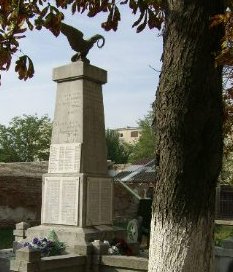
  Nădlac was fortunate not to be in the middle of the horrors of
war but there were many people who participated and as you
can see by the names on the monument to their war dead,
many died in battle.

                  
       WW I + II monument to war dead from Nădlac

      
        Probably is impossible to read. There are 2 other
            plaques filled with names on this monument

   The Russian army really just passed through on their way West
towards Germany. At this point in time there weren’t any problems
and life was pretty much routine. Stefan mentioned that life didn’t
start to become difficult till around 1948 when the communist came
to power or began to take a more forceful approach. It really became
severe in the early 1950‘s.

   Stefan was fairly well to do at the time and that made him and the
people like him targets. He himself had his house taken from him
including land and other possessions. Some of his taken land was
made public land and can’t be recouped. The communists would
just take whatever they wanted at any time without any compensation
or reason. Many people lost everything. I asked him about his house
and that I has heard that he had had a problem. He told me that they
came to his house, told him they had 48 hours to get out. The
communists took a block of 5 houses with his being one of them. I
believe it was for military use and four years later to the day that
they told him to leave, they themselves evacuated his home. The
probable reason they left was that the house was virtually destroyed
and useless at that point. They just ruined everything, there were
no doors or windows and there were holes in the walls. Stefan
returned to his home and repaired without any compensation.

   Stefan was also brought to the mayor’s office and beaten. At that
time there were two prison cells in that building. He was brought at
the same time as another elderly lady. Both were beaten. I asked
him: “why?”. He answered “ I think it was because I was a little
well to do, they didn‘t explain why, they never did“. I believe that
this happened to him a total of 3 times.

    I also asked him if anyone profited during this time and he said
yes there were people who did. They were the ones that
collaborated with or were part of the communists party. Stefan
said that at any time of the day one of the officials (police,
secretaries or any other type) would just come to one’s house
and if they wanted something that you had, they took it. I asked
him if there were any people still here that were collaborators
or profiteers. He said that about all of them had died and that
there were just a couple left. He didn’t name names and I didn’t
ask. I also asked if there were any incidents of revenge, and he
said that there wasn’t that he knew of. My opinion is that it is
better that way.

   The communists also executed two people and when I again
asked why he told me in his opinion it was just to make a point.
His next door neighbor was one of the people executed and
it was a lady, but I forgot to ask what her age was at that
time.

   Stefan mentioned a few things that were very interesting and
that it that it was much more difficult while Stalin was alive.
Also he said that he wouldn’t wish that experience on even his
worse enemies. So I am sure that there is a lot more to it.

   Again I have to admit that I am not a journalist and I have to
apologize if I didn’t do this subject justice. I have to say that it
is really an experience to be able to sit with a man like Stefan
and be able to discuss this subject. As his daughter Betty
mentioned people really don’t want to think or talk about it.
That is why I consider myself fortunate and honored to have
had the chance.

   Stefan is just one of the inhabitants who have had these
very bitter experiences. I can only imagine what other tales
people have that are similar or worse.

   For me, before arriving in Romania the extent of my
knowledge of life behind the iron curtain in a communist country
was limited to basic history. Facts like when the communists
arrived, when they left, Ceausescu … etc. I always heard about
how if people behind the iron curtain got caught listening to the
‘Voice of America’ they could get shot. (Don’t know how true that
was). But what I thought of was … what did we ever hear of the
lives of the people themselves. Not just the big shots. So I hope
that this article is of some interest to you and will give you a little
insight to the lives of regular people during Romania‘s communist
time.

Thursday, October 05, 2006

An article about Romania’s an auto called 'Dacia'

   The next paragraph is a condensed historical description
of the company.

   Dacia, the brand around which the Romanian auto industry
was created and developed, came into existence in 1966, at
Colibasi, Arges district. A close cooperation evolved between
Dacia and Renault from the very beginning. Dacia has been
an integral part of the Renault Group since 1999 and it is
currently becoming more and more visible as an international
brand. In 1998, the anniversary year of three decades since
producing the first ever Dacia car the vehicle number
2,000,000 came out of the plant.

   This is not to say that the Dacia is the only car here, there is
about any make of automobile that anyone would want. It is
just that this car is what my brother-in-law would call ’A Classic’.
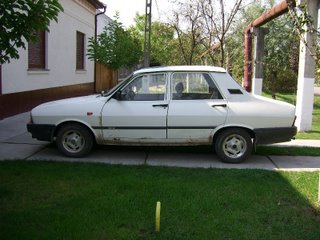
As you can see by my neighbor’s 1998 4-door.


  This one is actually pretty ‘misto’ Rroma/Gypsy word for
‘cool’ because of the wheels. The owner of this ‘classic’ Dacia
is Mr. Pavel. He’s had this one for about 8 years because he
bought it brand new in ‘98‘.

          
This photo almost puts you behind the wheel of a ‘98‘ Dacia.

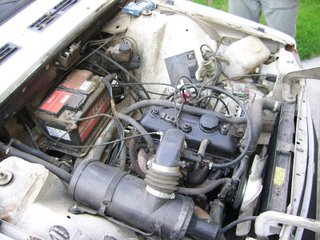
  Below you can see what powers the Dacia on and off road,
you see these cars going everywhere. One advantage to the
older Dacia is that they are very economical to repair. But as
someone mentioned ... if you have to repair it weekly, is it
really that economical? Probably that is why it is not unusual
to see 20 year old cars still motoring down the highways and
traversing fields.


   The power plant is a four cylinder and I have seen some that
run on propane. What they do is place a propane tank in the
trunk and people have mentioned that it costs almost 50% less
than regular fuel, here fuel is called ‘benzina‘. Mr. Pavel’s Dacia
is not propane powered.

   It is kind of funny how a vehicle kind of relates to one’s Peace
Corps experience. In El Salvador it was the ‘chicken buses’ …
the brightly painted and decorated old yellow school buses with
Salsa style music blaring. In Senegal it was the Peugeot station
wagon that was called ’7-palaas’. Both of those being the main
modes of public transportation. Though the Dacia isn’t a means
of public transportation it is similar to the others as just the
mention of it's name will forever trigger memories of Romania.

          
Older models of the Dacia, the typical four door and station wagon

   A few volunteers from the Senegal tour would mention that when
they returned to the States, they had this crazy desire to buy
a Peugeot station wagon. Some even looked on E-Bay and found
some. Don’t know if they bought any. But you know, having a
little Dacia wouldn’t be that bad a thing. Also seeing that it is
becoming an international brand I may be able to buy a brand new
one. Right there in the ole USA.

Tuesday, October 03, 2006

I have to make a couple of retractions ...

   to the information that I posted in some past articles in.

   The corrections are more specific to the article/posting
of the coffee shop.

 First the coffee shop owner’s name isn’t Radi.    
Her name is Roska.

  Also the man in the middle of the three gentleman
named Stefan (that is his name, I got that right)
didn’t work for a TV station.

     
                He really was a TV repairman.

  Ok, how did these mistakes happen? I think it has
to do to the fact that after 5 months there is still a
lot more of the Romanian language that I need to learn.

  Which leads into the real purpose of this posting …
and that is to describe the pretty funny and interesting
situations that you can get into when you don’t really
have a handle on the language. I know that I just plain
didn’t understand what they said. The name was kind
of easy and I probably should have gotten that one. But
the TV repairman thing was a little more complicated.
The words ‘prepara’ and ’repara’ are pretty similar. So
of course you can see that one is to prepare and the
other is to repair. I guess when he told me what he did
(at about 90 mph Romanian) I just didn’t get it. I thought
that he prepared TV programs.

  Of course that isn’t the only two times that’s happened.
The other day I went to the local school and with a teacher
we went to the park. The kids are from the 5th grade and
they went to the park for a lesson to learn the trees, flowers
… etc. I took my little digital camera and took some pictures
and movie clips. After that I was going to make a little
amateur film showing the kids naming plants, trees and
flowers.

  I put the little film together and I put in some frames
with words in them, of course the words were in Romanian.
I was lucky enough to have a person take a look at it. Good
thing, in one of the frames I put in Romanian ‘ A tree ‘. I
wrote it this way ‘ O Capac ‘. It should have been ‘ O copac ‘.
I will explain the differences in the words. ‘ O copac ‘ means
a tree. ‘ O Capac ‘ means the cork on a bottle of wine. So …
good thing he looked it over. I could just imagine the kids
watching this little film and that frame comes up … cork of a
wine bottle … then the next clip comes up with a little girl
pointing to a tree and saying it‘s name. Could have been kind
of funny. If you think of it it is kind of funny.

  One other experience was a few weeks ago I went to this
church in the city of Timisoara, about 100 kilometers away.
After the service I was invited to talk to the pastor. They
were a few of us there and we had a discussion. In this point
of the discussion we were talking about parents and their
children. So I said in Romanian what I thought was ‘ you
should love your children, shouldn’t you'? The word for
children is ’copii ’. I used the word copac (that word again)
which again means ’tree’. So after they stopped laughing …
which took a few minutes … they told me that they do love
their trees. But they asked what does have to do with a
parent and children?

  Of course these are just a few of the instances and they
have been many more than I want to remember. It is sure
that they will be a lot more.