Monday, October 23, 2006

Romania was a former communist country ...

   with it most notable for the Ceaucescu regime. I consider myself
very fortunate to be able to live here for 2 years. The reason
being is that it takes time to learn not only about the country,
as in the sites and customs, but also of the lives of the people
themselves.

   It came to mind that despite being in a former communist
state that I only knew the plain historical facts of Romania.
The genuine incentive for this article was the thought
… what about the people? How were their lives throughout
this time. I am not an historian or a journalist by any means.
I hadn’t noticed much information concerning the lives of
ordinary people in Romania or any former Iron Curtain
country for that matter.

   So, I mentioned this to a small number of elderly people. I
said that people from the USA really knew utterly nothing
of how it was here in Romania during this period. I was
extremely lucky to meet an 84 year old man named
Stefan Janczik seen below.

     
                                  Mr. Stefan Janczik

   With the help of my friend Marienka I was blessed with the
opportunity to meet and discuss this issue with Stefan.

   When I mentioned my interest of the post WWII communist
times here in Nădlac, one and all mentioned that he would be
the best one to speak to. He has an incredible memory and
it was amazing, but he out of anyone else I have ever met,
reminds me of my father. Until my father’s last day he had
this incredible memory, even at the age of 92.

   I was brought to Stefan’s house by my friend Marienka and I
was also fortunate to meet his daughter Betty and her husband
Vasile. Who live in the Capitol Bucharest but were here in
Nădlac visiting. They were an immense help as they can both
speak excellent English. I wish my Romanian was better but
in time it will be, that is my goal.

  With what Stefan knows I could probably have enough material
to keep me writing in this blog for the next couple of years.
What I really was interested in was what happened here in
Nădlac after the end of WWII and how it affected their lives in
this small border town during communist rule.

  Nădlac was fortunate not to be in the middle of the horrors of
war but there were many people who participated and as you
can see by the names on the monument to their war dead,
many died in battle.
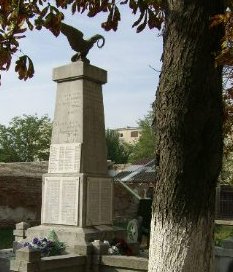
                  
       WW I + II monument to war dead from Nădlac

      
        Probably is impossible to read. There are 2 other
            plaques filled with names on this monument

   The Russian army really just passed through on their way West
towards Germany. At this point in time there weren’t any problems
and life was pretty much routine. Stefan mentioned that life didn’t
start to become difficult till around 1948 when the communist came
to power or began to take a more forceful approach. It really became
severe in the early 1950‘s.

   Stefan was fairly well to do at the time and that made him and the
people like him targets. He himself had his house taken from him
including land and other possessions. Some of his taken land was
made public land and can’t be recouped. The communists would
just take whatever they wanted at any time without any compensation
or reason. Many people lost everything. I asked him about his house
and that I has heard that he had had a problem. He told me that they
came to his house, told him they had 48 hours to get out. The
communists took a block of 5 houses with his being one of them. I
believe it was for military use and four years later to the day that
they told him to leave, they themselves evacuated his home. The
probable reason they left was that the house was virtually destroyed
and useless at that point. They just ruined everything, there were
no doors or windows and there were holes in the walls. Stefan
returned to his home and repaired without any compensation.

   Stefan was also brought to the mayor’s office and beaten. At that
time there were two prison cells in that building. He was brought at
the same time as another elderly lady. Both were beaten. I asked
him: “why?”. He answered “ I think it was because I was a little
well to do, they didn‘t explain why, they never did“. I believe that
this happened to him a total of 3 times.

    I also asked him if anyone profited during this time and he said
yes there were people who did. They were the ones that
collaborated with or were part of the communists party. Stefan
said that at any time of the day one of the officials (police,
secretaries or any other type) would just come to one’s house
and if they wanted something that you had, they took it. I asked
him if there were any people still here that were collaborators
or profiteers. He said that about all of them had died and that
there were just a couple left. He didn’t name names and I didn’t
ask. I also asked if there were any incidents of revenge, and he
said that there wasn’t that he knew of. My opinion is that it is
better that way.

   The communists also executed two people and when I again
asked why he told me in his opinion it was just to make a point.
His next door neighbor was one of the people executed and
it was a lady, but I forgot to ask what her age was at that
time.

   Stefan mentioned a few things that were very interesting and
that it that it was much more difficult while Stalin was alive.
Also he said that he wouldn’t wish that experience on even his
worse enemies. So I am sure that there is a lot more to it.

   Again I have to admit that I am not a journalist and I have to
apologize if I didn’t do this subject justice. I have to say that it
is really an experience to be able to sit with a man like Stefan
and be able to discuss this subject. As his daughter Betty
mentioned people really don’t want to think or talk about it.
That is why I consider myself fortunate and honored to have
had the chance.

   Stefan is just one of the inhabitants who have had these
very bitter experiences. I can only imagine what other tales
people have that are similar or worse.

   For me, before arriving in Romania the extent of my
knowledge of life behind the iron curtain in a communist country
was limited to basic history. Facts like when the communists
arrived, when they left, Ceausescu … etc. I always heard about
how if people behind the iron curtain got caught listening to the
‘Voice of America’ they could get shot. (Don’t know how true that
was). But what I thought of was … what did we ever hear of the
lives of the people themselves. Not just the big shots. So I hope
that this article is of some interest to you and will give you a little
insight to the lives of regular people during Romania‘s communist
time.

Thursday, October 05, 2006

An article about Romania’s an auto called 'Dacia'

   The next paragraph is a condensed historical description
of the company.

   Dacia, the brand around which the Romanian auto industry
was created and developed, came into existence in 1966, at
Colibasi, Arges district. A close cooperation evolved between
Dacia and Renault from the very beginning. Dacia has been
an integral part of the Renault Group since 1999 and it is
currently becoming more and more visible as an international
brand. In 1998, the anniversary year of three decades since
producing the first ever Dacia car the vehicle number
2,000,000 came out of the plant.

   This is not to say that the Dacia is the only car here, there is
about any make of automobile that anyone would want. It is
just that this car is what my brother-in-law would call ’A Classic’.
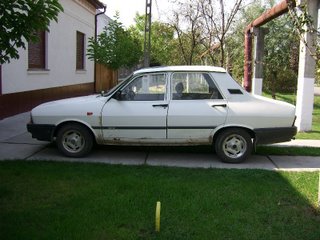
As you can see by my neighbor’s 1998 4-door.


  This one is actually pretty ‘misto’ Rroma/Gypsy word for
‘cool’ because of the wheels. The owner of this ‘classic’ Dacia
is Mr. Pavel. He’s had this one for about 8 years because he
bought it brand new in ‘98‘.

          
This photo almost puts you behind the wheel of a ‘98‘ Dacia.

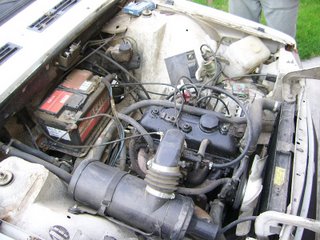
  Below you can see what powers the Dacia on and off road,
you see these cars going everywhere. One advantage to the
older Dacia is that they are very economical to repair. But as
someone mentioned ... if you have to repair it weekly, is it
really that economical? Probably that is why it is not unusual
to see 20 year old cars still motoring down the highways and
traversing fields.


   The power plant is a four cylinder and I have seen some that
run on propane. What they do is place a propane tank in the
trunk and people have mentioned that it costs almost 50% less
than regular fuel, here fuel is called ‘benzina‘. Mr. Pavel’s Dacia
is not propane powered.

   It is kind of funny how a vehicle kind of relates to one’s Peace
Corps experience. In El Salvador it was the ‘chicken buses’ …
the brightly painted and decorated old yellow school buses with
Salsa style music blaring. In Senegal it was the Peugeot station
wagon that was called ’7-palaas’. Both of those being the main
modes of public transportation. Though the Dacia isn’t a means
of public transportation it is similar to the others as just the
mention of it's name will forever trigger memories of Romania.

          
Older models of the Dacia, the typical four door and station wagon

   A few volunteers from the Senegal tour would mention that when
they returned to the States, they had this crazy desire to buy
a Peugeot station wagon. Some even looked on E-Bay and found
some. Don’t know if they bought any. But you know, having a
little Dacia wouldn’t be that bad a thing. Also seeing that it is
becoming an international brand I may be able to buy a brand new
one. Right there in the ole USA.

Tuesday, October 03, 2006

I have to make a couple of retractions ...

   to the information that I posted in some past articles in.

   The corrections are more specific to the article/posting
of the coffee shop.

 First the coffee shop owner’s name isn’t Radi.    
Her name is Roska.

  Also the man in the middle of the three gentleman
named Stefan (that is his name, I got that right)
didn’t work for a TV station.

     
                He really was a TV repairman.

  Ok, how did these mistakes happen? I think it has
to do to the fact that after 5 months there is still a
lot more of the Romanian language that I need to learn.

  Which leads into the real purpose of this posting …
and that is to describe the pretty funny and interesting
situations that you can get into when you don’t really
have a handle on the language. I know that I just plain
didn’t understand what they said. The name was kind
of easy and I probably should have gotten that one. But
the TV repairman thing was a little more complicated.
The words ‘prepara’ and ’repara’ are pretty similar. So
of course you can see that one is to prepare and the
other is to repair. I guess when he told me what he did
(at about 90 mph Romanian) I just didn’t get it. I thought
that he prepared TV programs.

  Of course that isn’t the only two times that’s happened.
The other day I went to the local school and with a teacher
we went to the park. The kids are from the 5th grade and
they went to the park for a lesson to learn the trees, flowers
… etc. I took my little digital camera and took some pictures
and movie clips. After that I was going to make a little
amateur film showing the kids naming plants, trees and
flowers.

  I put the little film together and I put in some frames
with words in them, of course the words were in Romanian.
I was lucky enough to have a person take a look at it. Good
thing, in one of the frames I put in Romanian ‘ A tree ‘. I
wrote it this way ‘ O Capac ‘. It should have been ‘ O copac ‘.
I will explain the differences in the words. ‘ O copac ‘ means
a tree. ‘ O Capac ‘ means the cork on a bottle of wine. So …
good thing he looked it over. I could just imagine the kids
watching this little film and that frame comes up … cork of a
wine bottle … then the next clip comes up with a little girl
pointing to a tree and saying it‘s name. Could have been kind
of funny. If you think of it it is kind of funny.

  One other experience was a few weeks ago I went to this
church in the city of Timisoara, about 100 kilometers away.
After the service I was invited to talk to the pastor. They
were a few of us there and we had a discussion. In this point
of the discussion we were talking about parents and their
children. So I said in Romanian what I thought was ‘ you
should love your children, shouldn’t you'? The word for
children is ’copii ’. I used the word copac (that word again)
which again means ’tree’. So after they stopped laughing …
which took a few minutes … they told me that they do love
their trees. But they asked what does have to do with a
parent and children?

  Of course these are just a few of the instances and they
have been many more than I want to remember. It is sure
that they will be a lot more.

Friday, September 29, 2006

Nadlac is a town ...

   that shares a border with Hungary.

   It is about a mile or one and a half kilometers
from the center of town.

   There is a border crossing and it is a pretty busy
place. There are regularly big trucks transporting goods
and many tourists passing through town.

   The main road ... as you can see in the picture below
is actually the beginning of the international road. With
Romania joining the European Union they are plans to
make this road into a larger highway that will cross the
country from here in Nadlac to the Black Sea city of
Costanta.
           
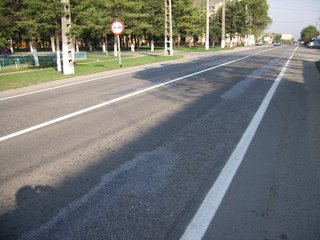
    In the above picture you can see the road that is coming
from the border. If you go down this road by car you
will be at the border in about 5 minutes. Also there
was a little excitement as you can see freshly painted
lines on the road. That happened just this week.
           
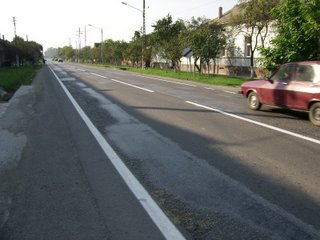
     In the picture above you see the road that leads into
Romania. All you need is approximately 900 kilometers
and 14 hours to Costanta. The next biggest city that you
will encounter is about 45 kilometers and it is called Arad.
   
   You can see a burgundy car on the right hand side.
It is really more like you can see about 75% of a car.
That car is the famous 'Dacia' built in Romania. It was
exclusively a Romanian built car but now it is in partnership
with Renault. I am not sure exactly when but I think that
it has been 5 or 6 years since the merger. I will try and
create an article about the Dacia soon. It is one of those
staple oldies that just keeps on going. People criticise it
as kind of junky but those things just keep running.

   Again with the European Union coming there is going to
be changes. In Nadlac one of the big changes will be
concerning the customs entry station. I have been told that
in a few years they will phase it out. That means that a lot
of people making a living from it will be out of jobs. A lot
of the Rroma (Gypsy) population make a living there. So
it will be interesting to see what they do when the border
station closes. I guess now is the time for them to think
about options. I don't know if I will be here when that
change occurs but if I am I will fill you in on how it affected
especially the Rroma.

Thursday, September 21, 2006

In Nadlac there is an approximately ...

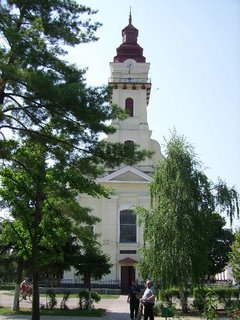
   200 year old Slovakian Lutheran Evangelical Church.
To be exact the church’s construction began in 1812
and was completed in 1821. The church itself
(congregation) began in 1803 and it received a
great boost in 1808 with the arrival of approximately
200 families from various towns in Slovakia.


   As you can see on the plaque below that it was built by the
Slovakian population that arrived in Nadlac and that they
laid the first stone in 1812. The plaque also states that the
church was declared an historical monument in 1977. The
language on the left is Romanian and on the right it is in
Slovakian.


    I hope that the first picture does justice to this beautiful old
church. But the real purpose of this posting is to describe one of
it’s truly unique traditions. For almost two hundred year this
church has had a continuous practice which I have not seen or
heard of before. This is not to say that it doesn’t exists anywhere
else but as of yet no one has been able to say that they have seen
or heard of a similar practice in another locality. Ok, what is all this
stuff I am speaking about ? What is this unique practice that has
been going on for so long? Let me give you a little hint … it has
something to do with the next picture. I am sure that anyone could
guess what it is by now. To tell you the truth, I doubt if you could.

               
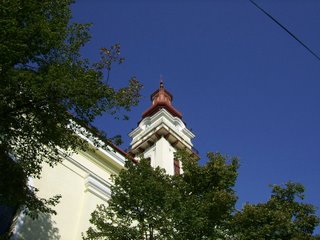
    Let me try another hint. In this picture you can also see two sides
of the walk way that surrounds the steeple. I think I am making this
too easy for someone to guess. Where is the fun, huh?

   If anyone guessed what you see in the next picture then give
yourself a pat on the back.

                    
                    Mr. Kochan Dusan sounding out the
                    time (5 p.m. September 19, 2006)

  There you can see the almost 200 year habit of having a person
with a trumpet sound out the time of day from the clock tower of
the church. It was told to me that this custom has been ongoing
from the time of the church’s completion, maybe even before. It
also continued non-stop during the WW II.

  This custom of announcing the time requires that a person
with a horn sound out an equal amount of beats that correspond to
the actual time of day. For example: 7 o’clock will bring 6 steady
distinct beats with the seventh being held for about twice the amount
of time as the other prior beats. It is also sounded out in the four
directions. A person will also, on the quarter hour, blast out beats in
conjunction to the time. For ¼ after there will be one beat, ½ past
will give you two beats and ¼ of will give you 3 beats.

  Of course to say that this happened all day at every hour and
quarter hour for 200 years would be an incredible story, but
untrue. Occasionally there are circumstances that could make
it impossible to sound out the time. But those circumstances
are practical ones. The guy may have to go to the field to harvest
his crops. That usually happens this time of the year. Also, the
church parish is building a retirement home and the guy that
sounds the horn is also aiding in the construction of that
structure. But what does happen is that even despite the fact
that they didn’t announce the time regularly they do sound it at
least a few times daily so as to carry on the custom.

  Here are some other tidbits of information concerning this
practice. The usual schedule (especially in winter) starts at 6
in the morning and continues till 11 at night. Right now there are
4 men that are sharing the duties of sounding out the time. Also
in the past there where families that lived in the church and took
the responsibility of keeping people informed of the time of day.

  As you can see by the other plaque in this last picture (which is
mounted on the right hand side of the main entrance, and is written
in Slovakian) that confirms that it has been over 200 hundred years
since the people who immigrated from Slovakia founded this church.


  So in conclusion I have to say that I am pretty lucky to be in a
place like Nadlac that has such a custom. I am sure somewhere in
the world there is something similar and maybe even somewhere
else in Europe. Despite that chance, this 200 year old ritual of
announcing time with blasts of a trumpet, still makes Nadlac
a little city with a pretty big tradition.

Friday, September 15, 2006

Usually when you start out in a Peace Corps tour

... especially when you’re the first one in your site, it takes a little
time to get some work/projects going.

  I am no exception to this rule and after being here in Nadlac for
almost 2 months it is still a process to get things rolling. The results
of it all is that I end up with some quantities of  free time on my hands.
The Peace Corps has three goals and the second and third goals are
to share cultures. So what better place to share cultures than at the
local coffee shop.

  Every morning between 9 and 10 I head out of the house to the
regular low budget coffee joint which you can see in the first picture.


  The proprietor is a lady whose name is Radi. Every morning
she suffers through my not so good Romanian and for her it
gets worse as I am trying to learn some Slovakian. Every
morning it is ‘ o cafea, ve rog’ (a coffee please, in Romanian)
and now it is ‘prosim si yedenu kavu’, which means the
same in Slovakian.

  This time of the year school has started and I am left daily with the
‘pensioners’ or what we call in the States ... retirees. You can see my
three coffee drinking buddies in the third photo. From left to right is
‘The Colonel’, Stefan and Michel. We are basically the regulars that
are there every morning killing time.


  One of the great things about having time to sit and drink the coffee
is that you get a chance to really get to know someone. Stefan (the
guy in the middle) worked in TV during his career. Michel drove big
trucks and ‘The Colonel’ was exactly what the name implies. He was
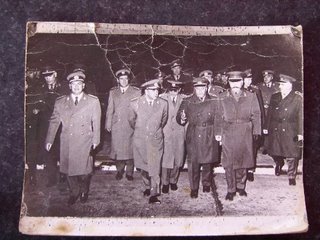
a Colonel for 32 years and he is a very educated man. He showed us
the fourth picture. He is in the middle with the sunglasses and behind
and above him is the head of defense from Czechoslovakia. Looking
again at the picture you can see to the left of the Colonel is the head
of defense for Romania and to the immediate right is the equivalent
for Slovakia. The person to the right of the Slovakian is a military
representative from Russia. The Colonel was translating between
Romanian and Slovakian. The picture dates from 1984 during the
Ceaucescu era.


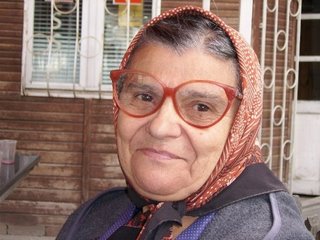
  The final picture is of a lady that happened to be there during the
photographing. Her name is Maria and she was excited about
having her picture taken and kept wanting to see her picture in the
viewer of the digital camera.


  I have to say that it is fun to hang out with these guys and they are a
wealth of knowledge. After I post this blog I promised to print out a
copy so that they can see the it. Radi the owner says that she is going
to tape it on the wall.

  So far I can’t say that I have been saving the world but I do hope
that I can make these people a little famous around the coffee shop.

Thursday, September 07, 2006

Time to make ‘ Tsoika ’

   … as promised in a prior posting there would
be an upcoming entry describing the making of what is called here
‘Tsoika’ and what we in the States call ‘moonshine’.

     As you can see in the first picture you take all the plums and
grapes you have and place inside the heater section of the ‘still’.
This particular one has about a 100 liter capacity.


   The blue barrel in the background is the condenser. The steam
comes from the heater and passes through a coil that is submerged
in water. This is where the vapor is cooled down to form a liquid.

     In the second picture you can see the complete assembly with
the tube connecting the heater section to the condenser. The tub
on the right hand side is used to drain out the plums after they
have extracted all they can from the respective batch.


   Also, you can see the big wooden vats in the foreground. All toll
there is about 2300 to 2500 liters of plums and grapes. So it
will take about 25 batches to finish all that is there. Each batch
is taking about 3 hours which they mentioned is longer than it
took last year. They are planning on going around the clock till
it is finished. The nights are starting to cool off, so being near the
fire ought to be nice.

     In the third picture you can see the tsoika/moonshine as it
leaves the condenser. This tsoika/moonshine is from the first
distilled batch.


     At this point they said that the alcohol content is an average
of between 40 to 45 %. Also, at this stage the name they call the
liquid is ’Vodka’. They know it is not actually vodka,
it is just the name they use. What will be done with the ’vodka’
is that they will take it and distill it again till it comes out at
approximately 60%. The final alcoholic content they desire is
something like 54%. This they do by some form of smeckeria.
I asked what smeckeria it could be but they said that this was
a ’secret smeckeria’. I’ll try and find out and if I do I’ll pass it along.

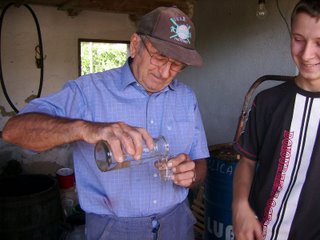
     The fourth and fifth pictures speak for themselves I would say
it is depicting him just literally drinking in the fruits of the labor.


   It is what this was all about and you can see the look of
accomplishment and satisfaction after all the hard work it
took. At the taking of these pictures there was only another
2300 more liters to distill.


   I am sure that he is going to have more than one more chance to get
that look of satisfaction.

Wednesday, August 30, 2006

Last weekend we had a ‘Nadlac Days’ Festival

   This was Nadlac's second annual festival to basically
just celebrate life. It was quite an event, there
had to have been around 4,000 people or more.

   They had some really great cultural dancers
and musicians playing from as far away as
Slovakia. Nadlac is approximately 49%
people of Slovakian descent and they have
kept many of their customs. They were Slovakian
dance troupes from Hungary, Serbia, Slovakia
and of course, Romania.

   There were also Bulgarian dancers from a
town in Romania that is majority Bulgarian.

   They were excellent and their music was
quite something and somewhat unique. It
was told to me that the root of that music
is based from Turkey.

   As you can see in the first picture that
there was a lot to see. That is a
Slovakian dance troupe from
Hungary. It is a crazy thing to
think that the traditional
Slovakian dance troupe
champions for 2006 are
right here from Nadlac. They
even beat out the dancers
from Slovakia. But unfortunately I
ran out of batteries for my camera and didn’t
get a chance to take a picture of them. After
seeing their performance I have to admit that
they are truly phenomenal.

   The second picture is of a Rroma (politically
correct term for ’Gypsy’) young kids dance
group. They are also from Hungary and that
is a pretty easy place to come from
seeing as Nadlac center is about
¾ of a mile from the Hungarian
border.

   We also had a group of Rroma kid
dancers from Nadlac but like the
Slovakian dancers they came on
after the batteries ran out. But
they were even more colorful
than the kids in this picture.
They also drove my friend nuts as
she is the neighbor to the house where
the kids practiced to about 4:30 a.m.
with the music blasting.

   I do have to say that this was a great time as
there were a lot of people who returned to
Nadlac to celebrate. There was a lot of beer and
a lot of people were happy but there wasn’t any
trouble. It was nice being able to go to a festival
and not worry about some form of violence. Also,
the events went on from 3 each afternoon till 5
in the morning.

  It all ended in a fireworks show that was
actually pretty nice.

   I did notice one thing, that this Monday morning
there were a lot less people running around town
than what one usually sees. I am sure a few of
them are suffering from what we call here
‘capul mare’… which translates in English
as ‘a big head’.

Monday, August 28, 2006

Before moonshine there must be wine.

   I guess I was a little ahead of myself
heralding that we will be making moonshine
soon. What I didn’t realize at the time was
that we had to make wine first.

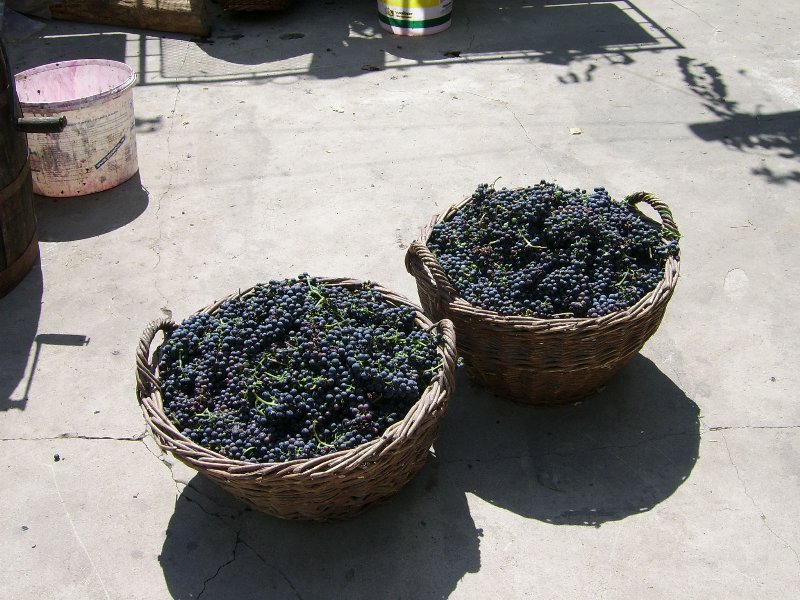
As you can see in the first
picture that it was time
to pick the grapes.
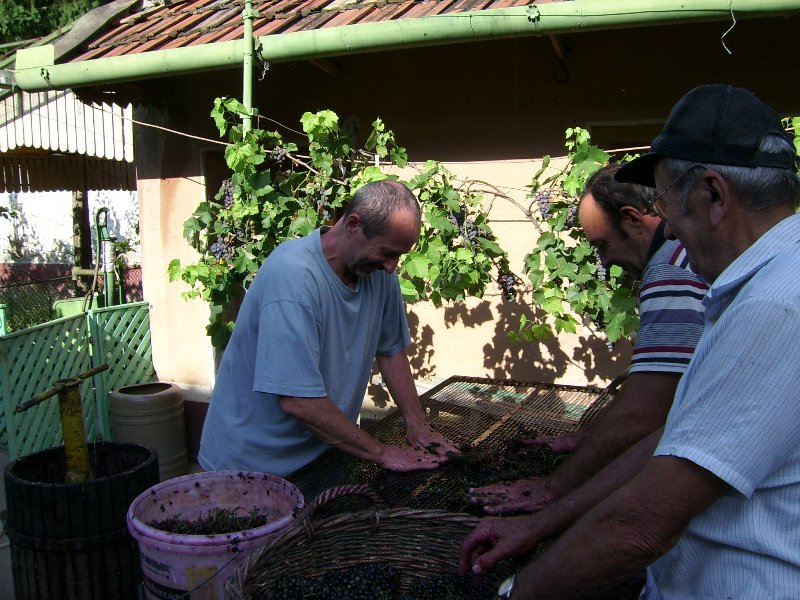
In the second picture
we were using what they
told me was a ‘smecker’ way
to separate the grapes from
the stem.

   The word 'smecker' is really an interesting
and humorous thing here in Romania.
I am sure in other parts of the world there
are other names for it but I have only seen
in such an obvious form here.

   You might want to know what ‘smecker’
means about now. Well ‘smecker’ means
‘tricky’. I guess that the way
we were taking the grapes off
the stems was a clever way
to do it. They explained to
me that there are two types
of people in Romania. The
smeckers and the people who
cry because they got smecked.
So far I haven’t been smecked
yet, or at least I haven’t
realized it. Also the word they use
when someone is doing a act of trickiness
… he/she is doing ’smeckeria’. I and they
think it is a pretty funny concept. Sure
makes for a lot of laughs so far.

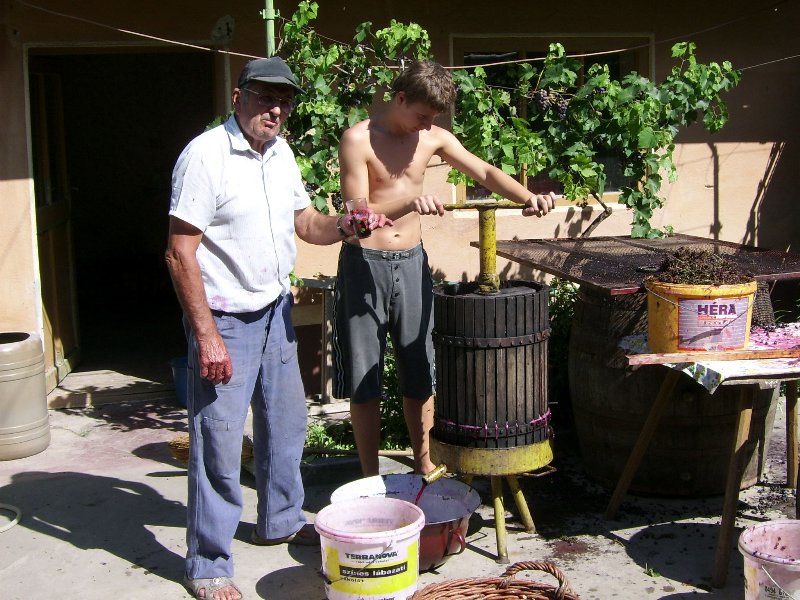
   Back to the wine making, the third picture
is pretty self explanatory. The grapes are
pressed and as you can see the results
(at that point) some pretty darn good
grape juice.

I don’t drink but the grape
juice was really good. After
that they put the juice in
some big jugs and as of right
now it is fermenting. I am not
sure but I think that in about two
weeks it should be close to
being ready.

   The leftovers of the pressed grapes aren’t
thrown away. They are being saved for
the upcoming moonshine/tsoika making
event.

   I have been told that next week is the
moonshine making time.

Should be a hoot.

Monday, August 21, 2006

Preview of upcoming events


This is a picture of what is
appoximately 2,500 liters
of plums which will be
turned into the drink
called 'Tsoika'. It actually
could be called moonshine
in the States. I have never
seen it done so it should be
a pretty decent experience.

I was told that it should take about 2 weeks or so at a part time clip
to finish all those liters of plums. They said that we should be 'stilling'
most of the nights through till completion.

So stand by and I'll try and explain the process of how
to make Romanian moonshine.

Tuesday, August 15, 2006

I was invited to a wedding


Or should I say that I was indirectly invited to a wedding
of a young Romanian boy of about 24 to a young Slovakian
girl of about the same age. What happened is my neighbor/landlord
was going to this wedding and they in turn invited me to go along. I
asked them if I needed an invitation and they said "no problem,
you’re with us’.

It didn’t start off too well as when we arrived at the restaurant
where the wedding was being held I immediately met the bride
an groom. And just as immediately the bride had this hurt look
on her face and asked basically " who ta hell was I ?". Of course
my better sense told me that it would have been easier with a
direct invitation and her reaction didn’t surprise me. My neighbors
told them that I was from the United States and that seemed to
make everything alright. She said "no problem he is American",
whatever that meant.

One thing about this Peace Corps gig is that when you start it is
always a test of one’s self confidence. For example, going to a
wedding where you really don’t know anyone. To boot, after
studying the Romanian language, and in fact still studying the
Romanian language (to the point where I can actually speak more
like a 5 year old instead of a 3 year old) I get to sit in the Slovakian
section. They’re speaking Slovakian and so of course I don’t
understand a word. Good thing I have a little bit of self confidence
and experience. I know that this lack of communication instances
will pass with time.

While I was sitting there not understanding much of the conversation
it gave me an opportunity to reflect on the differences between
the 3 cultures I have been living in through my Peace Corps tours.

Of course it is too early to speak expertly of the Romanian culture
but there are some obvious differences. I am going to speak about
the general social interactions and what I think are some differences.
First the Salvadoran culture is not quite what one would consider an
open culture. They are really the nicest people when you start talking
but you have to usually start with them first. I am not sure if the 12
year war they had is one of the main reasons for that, I am sure
it did. In Africa those people were really open. Of course being
white in a black society would make one stand out and get
a lot of attention (good and bad). But here, it is not quite as
open as the above two cultures. I have been told that it is a residue
of the Communist and Ceaucescu eras.

I have also another theory that I am going to investigate during
my time here. I think that to add to the Communist angle is the
fact that here it is more developed in a material way. It seems that
some of the problems could be a side effect of what I have to describe
for a lack of a better term as a direct result of too much material
development. It is similar to the States, the kids are in front of
the tube and playing computer games all the time.
We know that this could be a detriment to developing social skills.
I sense this suspicion when people see me or meet me for the first
time. It is interesting to think that this could be the result of a
collaboration of a Communist philosophy with a materialistic
mentality. It will be equally interesting to find out if my suspicions
about this behavior are true or false.

I also must be honest and mention the other side. If the Romanians
get to know you they are as generous and hospitable as they come.
It is really interesting to see actual physical transformation when
they accept you. It is so apparent and obvious.

Getting to describe the wedding, again it is as different from
El Salvador and Senegal as the distance between them. In El Salvador
I don’t remember anyone actually getting married. They moved
in together but never married. In Senegal it was really more of
an event where the women participated more than the men,
except the husband of course. I can’t describe a Salvadoran
wedding but I can an African one and there the women dance
the most. There is a big difference here in Romania. Here the
men and women dance, all night, I didn’t see them dance one
second without touching each other. The band played traditional
songs in the Romanian and Slovakian languages. I actually danced
some and again it comes back to self confidence. It is the first time
that I had to dance in their fashion so it took a few steps to get
with it. So you have to appear a little foolish at first before you
get it. Of course making my Romanian dancing debut in front of a
bunch of people I don’t know is always a day to remember.

I also have to say that there was plenty of food at the wedding
and also the local moonshine called ’ Toica ’. It is actually
pronounced ’tsoi-ka’, I need to have a keyboard that
puts a little ’s’ under the T for you to get the right sense
of the pronunciation. It is also an interesting note that
despite the fact that the Slovakians have been here
for 200 years there is still this ’he is married a Slovakian
girl’ thing going on. That Slovakian family has been in
Romania for over a 125 years but they still firstly consider
themselves Slovakians. As of this writing I have been a
citizen of Nadlac for a whole 2 weeks. So, of course be aware
that these are my first impressions and I am going to say
that as I learn more I will probably change or modify these
impressions as time goes on.

I also talked to my neighbor’s son and though he wasn’t at the
wedding he said that as far as Romanian/Slovakian weddings
go this was a rather small one (100 people only). He said that
times have changed some and that in a more traditional wedding
there are usually about 300 people. Now get this, 300 people per
spouse. Also, he mentioned that they also usually have 2
ceremonies going on at the same time. The groom has a reception
separate from the wife’s and each one would have about 300
people. Also, he also mentioned that there usually is this person
(always seems to be the drunkest one) that dresses up in a
bear suit with someone leading him on a chain. He actually is
kind of like the jester and entertains. I haven’t seen those type
of traditional weddings so I am only passing on what was told to
me. Hopefully during my time here I will get the chance to
witness those traditions.

But to conclude all this I have to say that it was one rocking
wedding and it is truly a huge social event with a lot of
participation. I have to give the Romanian/Slovakian wedding
ceremony a big thumbs up.

Sunday, August 06, 2006

Training is over and off to the site:

I arrived in Nadlac on Saturday the 29th of July. It took a
8 and a half hour train ride and then another hour ride by
car to get here, but it all went smoothly.
It was a different trip from the site visit as this time I knew
that this is where I will be for the next two years. Well so far
it has been really easy. The counterpart I have is really super
and has been with me throughout the settling in process. I have
met the mayor, police chief, librarian, the priests, the head of the
local bank and many other people. My Romanian language skills
are lacking some at this point so the discussions are pretty basic.
Also, here, almost everyone speaks Slovakian and that is quite
something seeing as the Slovaks first came here 200 years ago.
There are 6th generation kids that speak Slovakian. It is
impressive that the people have kept their heritage this long. Of
course they all speak Romanian. So this gives me a chance to
learn the Slovakian language and I have picked up a few words.
But I will actually wait a few months till the Romanian
gets better then I will start on Slovak.
After 4 days here I did attend a Slovakian funeral, it was that
of a lady that died in Israel on the 17th of July. She didn’t die
directly as a result of an attack but rather indirectly. The story
goes that she went to Israel to earn some money. Supposedly her
husband drank a lot and had a hard time with money. So she
went to Israel to work as a live in maid with two older gentlemen.
I guess she had some heart problems and there were rockets
landing in the town or area she was in. At the seventh rocket
she started getting chest pains from the stress and between the
seventh and eight rocket landing she died of a heart attack. She
was 52 years old.
I received an invitation to attend the funeral and went. The most
distinct parts of the funeral was that it was all in the cemetery. There
they have what would be equivalent to a funeral home. They passed
out moonshine and sweetbread. The next day was the actual burial
and again all the ceremonies where at the cemetery. The priest
came and gave his eulogy. They pinned a white handkerchief to our
shoulders and we all (about 200 people) marched in procession to
the plot. The casket was lowered by rope and it was at that time when
everyone burst out in tears. It was sad.
Many of the Romanian people have asked me what do the people
from the United States know about Romania. It is the same old
answers they always hear, Dracula, Nadia Comaneci (the gymnast)
(I am not sure of the spelling of her last name) and Ceaucescu and
not much else.
I do hope through this blog that I can give you some insights to
Romania and it’s people.

Thursday, July 27, 2006

Swearing in.

After our ten weeks of training all we needed to do was
raise our hands and swear in to be official Peace Corps
volunteers. We did that on Friday the 28th of July in
the city of Ploiesti. The mayor was there and we heard some
very nice speeches. Also, we had a slide show of pictures
taken throughout our training cycle, it was very well done.

The next day we were off to our sites and as I mentioned
before mine is Nadlac, a border town. After a 9 hour train
ride followed by another hour car ride I arrived to my new
home.

I have placed my things in my new residence and it is a very
nice little old house about 3 walking minutes from the center
of town. So I have time to basically hang around till Monday.
On Monday I am going to meet the mayor, police, doctor and
probably a few vendors in the stores because I need to get
settled in. It should be a very hectic first week with those
types of activities surrounded by not much else to do. I will
meet the members of the NGO that I will be working with
either Wednesday or Thursday. They are a brand new NGO
so it will take some work to get things started.

One of the issues that should occupy my time here is in regards
to Romania entering the European Union. There will be a lot
changes made, and fairly soon. Romania will join the EU on
the first of January. It should be interesting to be here
for the beginning of this transitional period.

Wednesday, July 12, 2006

Nadlac - that's the name of the my new site.

Well ... last Saturday we all (70 of us) headed out to visit what
will be our homes for the next couple of years. I think that
everyone seems satisfied with what they have received.

As I have written, the name of my site is called Nadlac which
is an Hungarian name, if I understood correctly. I have to say
that this will definitely be a different Peace Corps experience from
my previous ones. This place is actually beautiful and if I walk
about the length of a football field (American Football that is)
I can see Hungary. We have border stations and the main road
of the little city (population 8,000) is an international highway.
Despite that, this place is just pretty, it is an almost 50/50 mix
of Romanian and Slovakian peoples. There are also some Serbs
and Hungarians and also Roma (Gypsies). 

There are Slovakian dance troupes and the greatest thing of
it all is that there is a 200 year old Evangelical Church that
has this unique custom. Everyday for 200 years there has
been a trumpeter sounding the times of the day. From about
5 in the morning till dark there has been men and their sons
walking out on the walkway of the steeple of this church and
in all four directions and playing their trumpets. Seven beats
for 7 in the morning or evening ... etc.

Needless to say again this is as different as different can be
for me. My Peace Corps experiences have been in villages of
350 and 300 people respectively. I am sure that there are
problems as equal in intensity in a little city of 8,000 as
there is in a village of 300, probably more, but a of different
flavor, obviously. They will be topics for future postings,
hopefully.

I am not too sure about the work yet but in two weeks when
I return we'll start figuring that out.

Other than that I guess I will be going to a lot of cultural festivals
right outside the door of my house.

Saturday, July 01, 2006

New Home;

We finally received the info on our sites which
will be our homes for the next two years. At this
point in our Peace Corps Romania service these
sites are really only names. We don't know if these new
homes will be good to us or not. We don't know the
people there and conversely they don't know us.
We don't even know where we will be living
or if we will be able to accomplish anything.
The name of my new site/city (pop. 8514) is called Nadlac.
It is located on the border between Hungary and
Romania and is supposed to be the place where
most of the people cross the border. Also, the
population is predominately Slovakian and this
may require that I learn another language or bits
of two others ... Hungarian or Slovakian. They are
Slavic languages and they don't have much in common
with Romanian. We will see how that pans out.
Tomorrow we meet our counterparts and then
Saturday it is off for a 3 day site visit. I am sure that
a lot of questions will be answered over the
next week. I am sure that those questions are not
only from me about them but also from them about me.
'Vom vedea' ... Romanian for ... we shall see.
Next week I hope to be able to write about some specifics.
Inchallah.
For you people who know this word ... sure fits
the instance this time.

Saturday, June 24, 2006

Week 5

Hello everyone ... we are completing the 5th week and so
far so good. It is the so called 'dog days' of training, people
are getting ansty to know where and what they will be
doing. That is coming soon as this week we will start
to have interviews to help decide the right fit for each
of us. After that we are on to what will be our permanent
sites (for 2 years) for a week to get a feel for them. Things
will start going along quickly and in almost exactly a month
we will be swearing in and then a few days after that
we are off to out sites. Today I am going to visit Dorina
and see how she is doing. This is an easy visit as she
speaks perfect French and though my Romanian is
progressing well, we couldn't have the same quality
conversation if we couldn't use French. Other than that
everything is going well as it could in the 'dog days' of the
training cycle.

Tuesday, June 06, 2006

3 rd week in Romania

Hello Everyone;

This is the third week in Romania and so far it has been nothing
more than language classes (which are going along well). So far
with being in a the large city like Ploiesti, language hasn't been a
problem as there are a lot of Romanians that can speak
English and French (among other languages). One part of our
training is that we have to do a project that will somewhat
parallel what we will be doing once we arrive in our sites.
They attach you to an organization and then we spend several
days working out a mini-project that will take no more than
3 or 4 days to implement. There are three of us, being Eric,
Kristina and me attached to the Social Service Department of
Ploiesti ... the sponsor of our project.
It is a really great opportunity to go along with the social
workers (whom are just superb) to see the people
that are in their programs. They do have quite a few
(underfunded) programs that take care of a range from children
to handicapped to elderly and even family planning issues. Also
the do some work with the Roma (Gypsies).
We had the great opportunity yesterday to follow along the
workers to a house of a lady named Dorina. She is an elderly
lady of 72 and has a very bad case of skin ulcers on her lower
legs. Her legs are huge from inflamation and she has no one in
the world. No family whatsoever and she lives on a very small
stipend that the Social Services provide. She has a home
caretaker that works/stays with her 40 hours a week, which
breaks down to 5 eight hour shifts, Monday through Friday. The
interesting part of this is that the lady caretaker was unemployed
and hired through the Social Agency. It adds up to getting
two birds with one stone. I thought that it was a really good thing.
First I must say that Dorina is such an interesting person. She
was a language teacher in villages throughout Romania a majority
of her life. She also worked for a TV/radio station during the
Ceaucescu regime. During that time Ceaucescu wouldn't allow any
other language than Romanian to be heard, spoken ... etc.
Dorina's job was to translate songs, poems and other things
to the Romanian language. She even showed us a couple of records
with her name on it and I believe that she even sang
some on the records. It was an interesting and fun encounter.